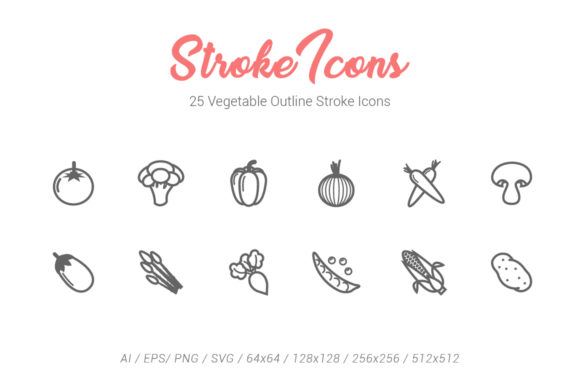
25 Vegetable Outline Stroke Icons
Let’s say you’re stitching a set of linen kitchen towels for a local boutique—soft, earthy, and meant to feel handmade but polished. You want something fresh but timeless: not too cutesy, not overly technical, just clean, recognizable, and quietly confident. That’s exactly where 25 Vegetable Outline Stroke Icons lands—not as a flashy statement, but as a thoughtful, versatile design asset that earns its place on fabric.
A First Look: Simple, Sincere, and Stitch-Ready
Opening the folder, the first thing that stands out is consistency—not perfection, but intention. Each icon is drawn with a single, fluid stroke: no fills, no gradients, no drop shadows. Carrots, peppers, garlic bulbs, artichokes, radishes—they all breathe with the same visual rhythm. There’s a gentle asymmetry in some (like the slightly tilted leek or the curving squash vine), which keeps them from feeling sterile. This isn’t clipart; it’s hand-guided line work translated into vector precision. For embroidery designers, that means fewer surprises when converting to stitch files—no hidden compound paths, no overlapping anchors, no rasterized elements masquerading as vectors.
Where These Icons Shine in Real Embroidery Projects
I tested three icons—zucchini, tomato, and pea pod—on a mid-weight cotton twill tote bag, a baby onesie (cotton interlock), and a woven patch backing. On the tote, the outlines translated beautifully into a clean running stitch at 8–10 mm height—crisp, legible, and uncluttered. On the onesie, I used a lightweight cutaway stabilizer and reduced stitch length slightly; the result was soft, breathable, and safe for baby skin—no stiff fill areas to irritate. The patch version held up well under heat-seal application and looked equally strong stitched or iron-on.
These icons naturally suit projects where subtlety and authenticity matter: embroidered aprons for farm-to-table chefs, tea towels for wedding favors, pillow covers for a garden-themed nursery, or sweatshirt chest logos for a small organic produce CSA. They also work surprisingly well as minimalist holiday embroidery—think a single beet icon on a linen stocking or a bundled bunch of carrots stitched onto a wool blend cap.
Where to Proceed With Care
Because these are outline-only icons, they rely entirely on stitch execution and fabric choice for impact. On highly textured fabrics like bouclé or thick terry cloth, fine strokes can disappear—especially below 6 mm in height. On stretchy knits (like jersey tees), you’ll need excellent stabilization and possibly a slight reduction in stitch density to avoid puckering around tight curves. Dark fabrics demand high-contrast thread—navy + mustard or charcoal + sage reads better than black-on-black, even with clean lines. And on curved surfaces like caps or baby beanies, test the placement early: the slender carrot tail or long onion stem may need subtle shortening or repositioning to avoid distortion.
Also keep in mind that true outline embroidery lacks the visual weight of satin or fill stitches. So while 25 Vegetable Outline Stroke Icons looks elegant on screen, it won’t “pop” the same way on low-resolution digital mockups or printed product tags unless paired thoughtfully—say, with a small botanical border or a handwritten font label.
What This Means for Your Craft Business
If you sell on Etsy or run a small shop, these icons offer quiet professionalism. Customers browsing handmade kitchen goods or baby items respond well to designs that feel intentional—not trendy, but grounded. A single outlined eggplant on a canvas market bag signals care, not haste. It supports brand consistency across product lines: same stroke weight on a patch, same rhythm on a tea towel, same clarity on a printable mockup for your listings.
For digital product sellers, the included .svg, .ai, and .eps files make customization straightforward—swap colors, resize proportionally, or layer with text without quality loss. Just remember: outline icons don’t auto-convert to machine embroidery files. You’ll still need to digitize each one properly—adjusting underlay, setting appropriate stitch angles for curves, and confirming minimum stitch lengths for your machine’s capabilities.
Practical Notes Every Embroidery Designer Should Keep Handy
- Always test on scrap fabric first—especially with new thread brands or stabilizers. What looks sharp on screen may soften on linen or compress on fleece.
- Check thread color contrast before stitching full runs. Light green on ecru works; pale yellow on oatmeal often fades visually.
- Review stitch density if digitizing yourself—outline-only designs can run too fast or skip on dense fabrics without proper tension calibration.
- Confirm hoop size compatibility—some icons (like the sprawling okra or long bok choy) extend beyond standard 4×4 hoops. Use the .ai artboards to preview layout options.
- Inspect small details at actual stitch scale: the tip of a scallion, the curve of a pea pod’s curl—these define recognition.
- Test black-and-white mockups to assess silhouette strength. If it reads clearly without color, you’re golden.
- Compare light and dark fabric backgrounds—not just for contrast, but for how the line weight feels against texture.
- Use proper stabilizer—lightweight cutaway for knits, tear-away for stable wovens, and fusible for patches.
- Verify licensing before selling finished items or bundling as part of a digital embroidery file pack. The product description doesn’t state commercial terms—so check the seller’s policy directly.
Final Thought: Design That Supports, Not Dominates
25 Vegetable Outline Stroke Icons isn’t about shouting—it’s about listening. Listening to the rhythm of a vegetable garden, to the quiet pride in a handmade gift, to the need for clean, scalable assets that don’t require constant tweaking. It’s the kind of graphics package that disappears into your process so your craftsmanship stays front and center. Whether you’re embroidering a single custom apron or building a full line of boutique kitchen goods, these icons give you room to breathe, stitch with confidence, and let the vegetables speak for themselves.