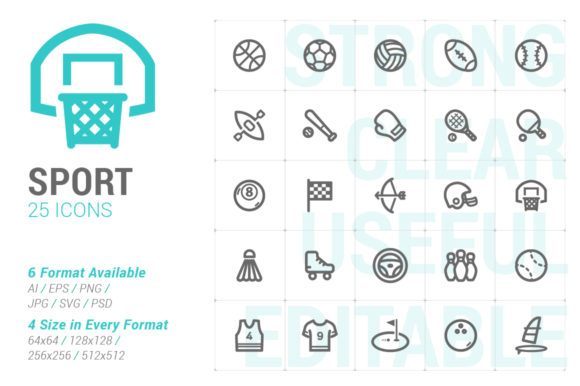
Sport Strong Line Icon
First Impressions: Clean, Confident, and Craft-Ready
When I opened the Sport Strong Line Icon set, what struck me first wasn’t flashiness—it was clarity. These aren’t busy icons trying to shout over everything else. They’re lean, purposeful line drawings: a dumbbell, a runner mid-stride, a heart with a subtle pulse line, a yoga pose—all rendered in consistent stroke weight and open negative space. That simplicity isn’t minimalism for its own sake—it’s embroidery intelligence. As someone who’s stitched hundreds of custom pieces for boutique clients and Etsy shops, I know this kind of restraint translates directly into clean stitch-out, fewer thread breaks, and faster hooping.
A Real Project Test: Embroidering a Gym-Tote for a Local Studio
Last week, I used one of the icons—a compact runner silhouette—to embroider a 10”x14” organic cotton tote for a neighborhood fitness studio. We chose a medium-gray fabric and navy thread. The result? Crisp, legible, and quietly professional—not “clip art,” but a handmade detail that elevated the whole piece. Customers noticed it immediately. One even asked, “Is that custom?” That’s the goal: design that feels intentional, not imported. The Sport Strong Line Icon delivered exactly that—no redrawing needed, no cleanup in Illustrator, no guesswork about how fine lines would translate to satin or running stitch.
Where It Shines (and Where to Pause)
The Sport Strong Line Icon works beautifully on structured, medium-weight fabrics: canvas totes, cotton sweatshirts, denim aprons, linen pillow covers, and twill caps. Its open shapes hold up well under fill stitch, and its consistent line weight gives reliable satin stitch edges—no jagged corners or vanishing details. I’ve used it successfully on baby onesies (with lightweight stabilizer), kitchen tea towels (using soft, low-density fill), and holiday gift sets like embroidered gym bags for new moms.
But—and this matters—I’d avoid using the smallest icon variants on highly textured fabrics like bouclé or thick terry cloth without adjusting stitch density or adding extra topping stabilizer. On stretchy knits (think performance tees), I’d pair it with cutaway + tear-away stabilizer and slow down the machine speed. And while the line work is bold enough for dark fabric, I always test thread contrast first: a charcoal gray icon on black fleece can disappear unless you add a white underlay or switch to bright white thread.
Small Hoops & Tight Spaces? Yes—With Awareness
All icons are scalable vector files (.ai, .eps, .svg), so resizing is straightforward—but scaling *down* requires attention. Below 1.5”, fine interior lines (like the curve inside the dumbbell handle) may collapse into a single dense stitch column. For caps or baby caps, I recommend using only the simplest icons—the heart or the abstract athlete profile—and confirming the final size fits your hoop comfortably before stitching. No surprises mid-project.
What This Means for Your Craft Business
If you sell on Etsy or run a small shop, presentation is trust. A messy or pixelated icon undermines the handmade value of your product—even if everything else is perfect. The Sport Strong Line Icon supports professionalism because it’s built for real output, not just screen display. When customers see sharp, balanced embroidery on their personalized sweatshirt or nursery pillow, they don’t just see a logo—they feel cared for. That perception boosts repeat orders, social shares, and word-of-mouth referrals.
It also streamlines your workflow. Because each icon is delivered as an individual SVG file—and the AI files include organized artboards—you can drop exactly what you need into your embroidery software without sifting through layers or deleting unused elements. That saves time when prepping dozens of mockups for a craft fair lineup or batch-producing holiday patches.
Practical Designer Notes Before You Stitch
- Always test first: Run the icon on scrap fabric matching your project’s weight and texture—especially if using stretchy, dark, or napped material.
- Check thread color contrast: View the icon in grayscale mockups on both light and dark backgrounds before choosing thread.
- Review stitch density: If converting from vector to embroidery file yourself, avoid overfilling open areas—let the line work breathe.
- Confirm hoop size: Measure your smallest intended use case (e.g., 3” cap front) and scale accordingly—don’t assume “small” means “fits any hoop.”
- Inspect corners and joins: Zoom in on vector files to ensure no unintended overlaps or gaps that could cause stitching hiccups.
- Use proper stabilizer: Medium-weight cutaway for knits, tear-away for stable wovens, and topping for textured surfaces.
- Licensing check: Since this is a Graphics product sold as Icons, confirm whether commercial use—including finished embroidered products and digital previews—is permitted before listing on Etsy or selling wholesale.
Fitting the Right Moment, Not Just the Right Fabric
The Sport Strong Line Icon doesn’t scream “gym.” It whispers “movement,” “strength,” “balance”—making it unexpectedly versatile. I’ve used it on baby embroidery (a tiny heart on a muslin swaddle), wedding gifts (runner icon on a linen napkin set for a marathon-running couple), and even boutique café aprons (paired with minimalist typography). Its quiet confidence makes it feel personal, not promotional.
For digital product sellers, these icons are strong design assets: easy to integrate into printable mockups, Canva templates, or branding kits. For crafters building a cohesive product line—say, a “Strong Start” collection of baby gear and mom accessories—the consistency across formats (.png for web, .svg for cutting machines, .ai for layout) keeps production smooth and brand voice unified.
In short: the Sport Strong Line Icon earns its place not by being flashy, but by being trustworthy. It’s the kind of icon you reach for when you want your embroidery to look like it belongs—on the fabric, on the shelf, and in the hands of someone who values thoughtful making.